

China is one of the world’s largest producers of industrial fabric, supplying materials for construction, logistics, automotive, advertising, and outdoor applications. Among the most widely produced materials are PVC fabric, PVC coated fabrics, and vinyl coated textiles made from polyvinyl chloride.
This guide explains how industrial fabrics are manufactured in China, from raw materials to finished rolls, along with quality control and buying considerations.
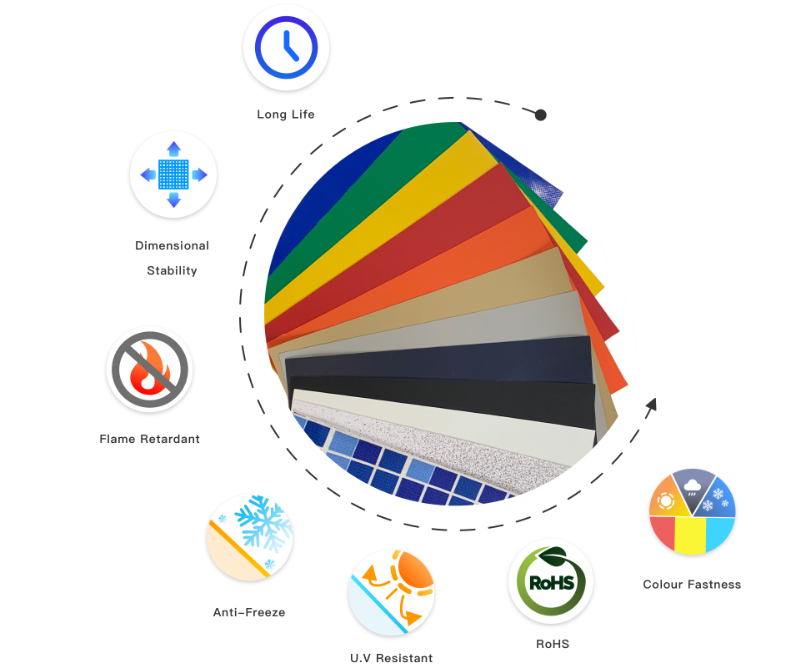
Industrial fabric is a technical textile engineered for durability, weather resistance, and mechanical strength. Unlike consumer textiles, it is designed for demanding environments such as outdoor exposure, heavy loads, and chemical contact.
PVC resin is the main polymer used to create coating layers. Additives are mixed to improve flexibility, durability, and UV resistance.
The base fabric provides tensile strength and tear resistance.
Polyester or nylon yarns are produced and woven or knitted into base fabrics. This step determines tensile strength and dimensional stability.
PVC resin is mixed with plasticizers, stabilizers, pigments, and additives to create a coating compound tailored for specific applications.
The coated fabric passes through ovens to cure the PVC layer, ensuring adhesion and surface durability.
Surface treatments improve:
Finished fabric is inspected for thickness, defects, and surface quality before being rolled and packed for shipment.
UV stabilizers protect PVC fabric from degradation and fading during outdoor exposure.
Base fabric density and coating thickness affect tear resistance and mechanical performance.
PVC coated and vinyl coated fabrics resist moisture, chemicals, oils, and environmental pollutants.
Plasticizers ensure flexibility in low temperatures and resistance to cracking in cold environments.
Many manufacturers comply with:
Check coating lines, weaving capacity, and monthly output.
Ask for test reports, certifications, and quality control procedures.
Leading factories offer custom:
Manufacturers with global export experience understand packaging, logistics, and compliance requirements.
PVC coated fabric is used for tarpaulins, tents, banners, inflatable products, and industrial covers due to its waterproof and durable properties.
PVC coated fabric uses liquid PVC applied directly to fabric, while vinyl coated fabric often uses pre-made films laminated onto the base fabric.
PVC fabric can be UV resistant when stabilizers are added to the coating formulation.
Tear strength depends on the base fabric density, yarn quality, weave structure, and coating thickness.
High-quality UV-stabilized PVC fabric can last several years outdoors, depending on climate and exposure conditions.
Yes, manufacturers can customize thickness, color, coating formulation, surface finish, and flame retardant properties.
Polyvinyl chloride is widely used in industrial applications and meets safety standards when manufactured and tested according to regulations.
Industrial fabric manufacturing in China combines polymer chemistry, textile engineering, and coating technology to produce durable materials for global markets. PVC fabric, PVC coated, and vinyl coated textiles made from polyvinyl chloride offer strong performance for outdoor, industrial, and commercial applications.
Understanding the production process, quality control methods, and material properties helps buyers and engineers select reliable industrial fabrics for long-term use.